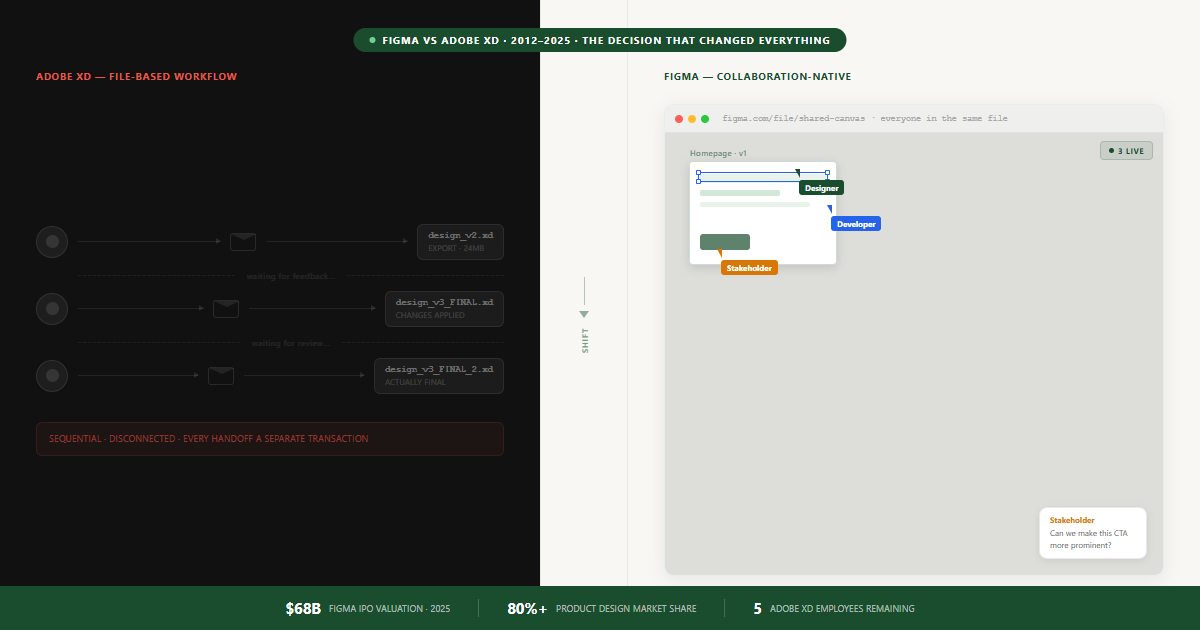
In September 2022, Adobe announced it would acquire Figma for $20 billion. Figma was ten years old, had never been a public company, and launched its first public product the same year Adobe XD did. Regulators blocked the deal. Adobe paid a $1 billion breakup fee. Adobe XD is now in maintenance mode, kept alive by five full-time employees.
This is not a story about a startup getting lucky. It is a story about one product decision made in 2012 that determined everything that followed.
What Adobe Already Had
In 2016, when Adobe released Adobe XD, it was already one of the most dominant companies in creative software. Photoshop and Illustrator had been industry standards for decades. Creative Cloud had locked designers into a subscription ecosystem. Millions of designers already trusted Adobe with their work.
XD was Adobe's direct answer to the growing demand for a dedicated UI and UX design tool. It was fast, native, and capable. It had prototyping, vector editing, and an export workflow that plugged directly into the rest of the Creative Suite.
On paper, Adobe XD should have won without a fight.
The Bet Dylan Field Made Before Anyone Was Watching
In 2012, Dylan Field received a $100,000 Thiel Fellowship - a grant with one condition: leave university and build something. He left Brown University with his classmate Evan Wallace and moved to San Francisco.
Field's framing of Figma was deceptively simple: what if design tools worked the way Google Docs did? Not as a file you saved and sent, but as a shared space that everyone entered together. Wallace had been experimenting with WebGL - a technology that lets browsers render graphics at a quality that previously required desktop software. Everyone Field pitched the idea to pushed back. Building professional design software in a browser felt absurd. One description that circulated internally: like "building a skyscraper with Roombas."
They spent four years building before a single user saw the product. Figma launched publicly in 2016.
The Decision That Couldn't Be Undone
Here is the specific thing Adobe could not copy.
Figma built real-time collaboration into its architecture from day one. Not as a feature added on top of a file-based system. As the foundation the entire product ran on. Every element in a Figma file lives on a server. Every change syncs instantly to everyone in the same file. The browser is not a delivery mechanism - it is the product.
Adobe XD was a desktop-first application. Files lived on your machine. Collaboration was built on top of that architecture, not underneath it.
This matters more than it sounds. You cannot retrofit real-time collaboration onto a desktop-first application the way you can add a new button or change a colour. The entire way data is stored, synced, and rendered would need to be rebuilt from scratch. Adobe would have had to stop being Adobe XD and start over.
There is a framework that explains why this was not just an engineering failure but an organizational one. Conway's Law states that organizations design systems whose structure mirrors their own communication structure. Adobe was organized around individual creative tools, each desktop-native, each built by separate teams with separate release cycles. That structure had produced Photoshop, Illustrator, and InDesign. It was not built to produce a real-time collaborative system, because Adobe's teams did not work in real time with each other on shared documents. Figma had no legacy teams, no existing architecture, and no organizational muscle memory pulling it toward file-based thinking. They built the tool to match how they worked, which happened to be how design teams wanted to work. The architectural gap was not just technical. It was the product of two organizations with two different internal realities.